
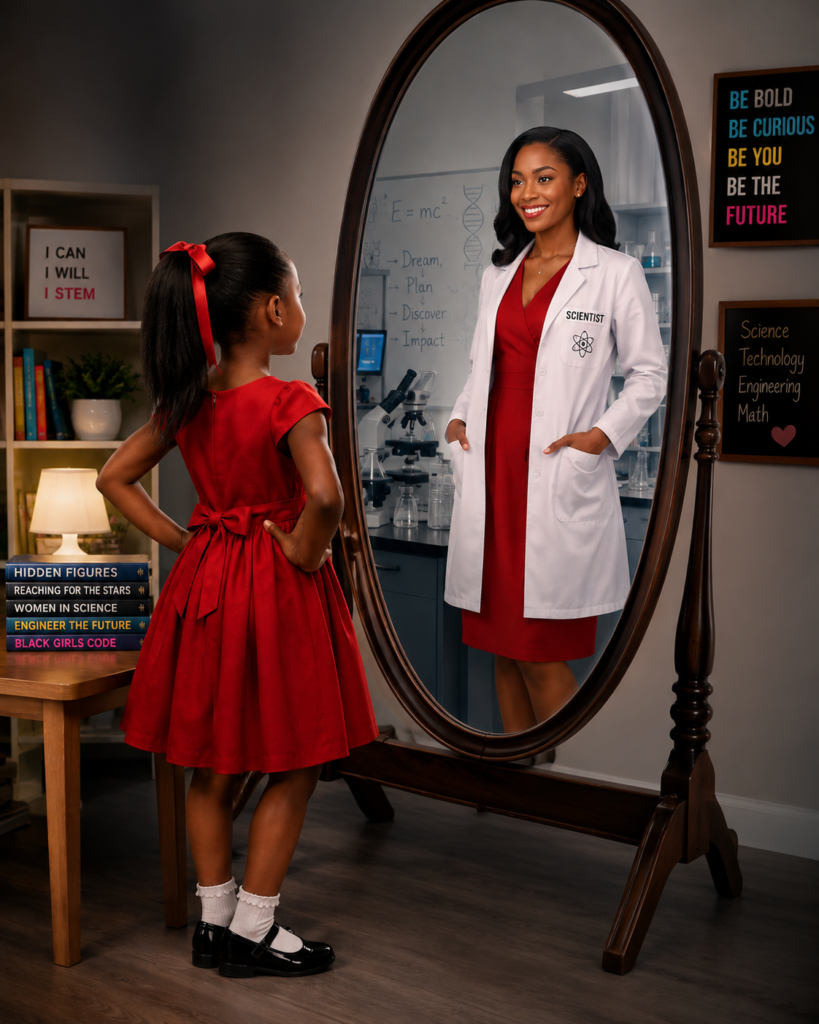
Walk into most classrooms or browse the science section of a children’s bookstore, and one thing becomes immediately clear: Black girls are rarely the face of STEM. Out of hundreds of children’s science books published each year, only a small fraction feature Black women or girls as scientists, engineers, or inventors. And in media? The numbers are even more discouraging. In popular science shows, animated programs, and even educational YouTube content, Black girls are consistently underrepresented or erased altogether.
Representation isn’t just a feel-good bonus—it’s foundational. Children begin forming ideas about who belongs where as early as preschool. When they rarely see scientists who look like them, Black girls may begin to internalize the message that STEM isn’t a space for them. This is where the concept of “mirrors and windows” in education becomes critical. Every child needs mirrors—reflections of themselves in books, media, toys, and classrooms—to affirm their identity and potential. They also need windows into the lives and contributions of others to build empathy and understanding. Right now, too many Black girls grow up surrounded only by windows.
The absence of mirrors has real consequences and leads to missed opportunities. Research has shown that early exposure to relatable role models in STEM significantly increases interest and confidence in pursuing those fields. Without that exposure, the pipeline narrows long before students ever step foot in a high school lab or college classroom. That’s not just a personal loss—it’s a societal one. When Black girls are excluded from STEM narratives, the world misses out on their ideas, innovations, and brilliance.
“For a long time, I didn’t think someone like me could be a scientist,” says Dr. Maya Green, a biomedical researcher and STEM mentor. “It wasn’t until college that I had a Black woman professor in a science class. If I’d seen someone like her in middle school—or even on TV—I might have discovered my passion much earlier.”
The lack of representation is not due to a lack of talent or interest. Black girls are just as curious, capable, and creative as any of their peers. The issue lies in access and affirmation. In many underserved schools—especially those in marginalized communities—STEM programs are underfunded, teachers may lack resources or training, and culturally responsive teaching is rare. Meanwhile, media producers often default to outdated stereotypes or avoid diversity altogether.
So, what can we do?
Start early. Change the narrative.
To change the narrative, we must start early—and be intentional. Exposure to STEM shouldn’t begin in middle or high school. It should start in preschool, kindergarten, and at home. Representation in STEM isn’t just about hiring more diverse faculty or producing a few inclusive shows. It’s about redesigning an entire ecosystem to affirm the brilliance of Black girls from day one. That means featuring Black women scientists on classroom walls, putting diverse STEM stories on bookshelves, and ensuring educational media shows that STEM looks like all of us. Bookshelves should be filled with stories that celebrate Black girl inventors, engineers, coders, and astronauts. Classrooms should display posters of real-life Black women scientists like Dr. Mae Jemison, Dr. Kizzmekia Corbett, and Dr. Ayana Howard.
We need more inclusive TV shows, educational games, and learning platforms that feature Black girls as tech-savvy, innovative, and intellectually curious. We need teachers who are trained to notice and nurture the potential of all their students—not just the ones who fit traditional STEM stereotypes.
Empower families and communities. Parents, community leaders, and STEM professionals all have a role to play. Whether it’s through after-school programs, library events, or mentorship networks, we can create environments where Black girls are not only welcomed into STEM—but centered and celebrated.
Representation matters because identity matters. When Black girls see themselves reflected in science, technology, engineering, and math, they begin to understand that they belong. And belonging builds confidence. Confidence fuels ambition. And ambition? That changes the world.
Girls Can’t Be What They Don’t See, so Representation Matters! The more that Black girls see themselves in STEM, they won’t just join the industry—they’ll transform it!